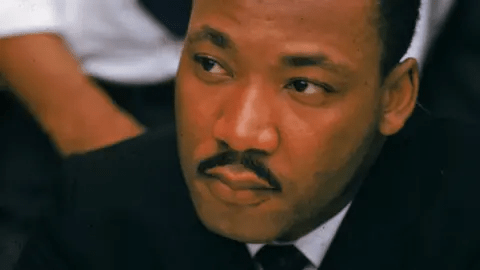
I gave this speech at a celebration of MLK in Pullman, WA, in 2023.
- Dear heavenly father, I ask that you provide us with a culture of freedom today. Allow us to be free today and be present. Allow us to be free from the evils of the world while we are here together. Let us be free so we can grow closer to you, so that we may ultimately grow closer to each other, so that we may have this culture of freedom. Glory to be the father, the son, and the holy spirit. As it was, in the beginning, is now and ever shall be. World without end. Amen.
- Since the moment I was invited to speak here today, I have been pondering what I would say to you all.
- Like, what do I say in a limited amount of time about a man who lived a limitless life?
- What words can I conjure together to try to make sense of a man who contributed so much good to the world?
- Selfishly, what words can I articulate to express so much gratitude to a man who means so much to me?
- It is very easy to say Dr. King changed the world.
- But I do not want to sound corny, cliche, or superficial.
- And, I certainly do not want to reduce his humanity to his work.
- So what can I say?
- Yes, Dr. King was a revolutionary, a civil disobedient, a practitioner of Non-violence, a leader in the civil rights movement, and a preacher.
- But he was a son, a brother, a husband, a father, a man.
- This is what I want to say today. Dr. King was a man.
- I think this is a critical thing to say.
- And I want to say it again. Michael King Jr. was a man.
- Noticed I said Michael King Jr., the name he was given at birth, and he shared with his father, Michael King Sr.
- But both his father and he would be known by the world affectionately as Martin Luther King.
- I share this with you because it might be something you didn’t know about Dr. King.
- I was asked to share some information with you all that you might not have known.
- There’s probably a lot you do not know about Dr. King because there is a whole lot I do not know.
- We would probably have to take a 2-semester course to just scratch the surface of King.
- And I ain’t got time for that right now, I gotta finish this dissertation.
- So today, I want to share Dr. King’s humanity with you.
- Like I said earlier, Dr. King was a man.
- It’s important to say this for two reasons.
- The first reason is that we live in a world that reduces, diminishes, and destroys Black humanity.
- And the latter being, white folks love Dr. King today, don’t they?
- On every Dr. King Day, we see every company sharing a quote from King. Always with a message expressing “we as a country are better because of his work”.
- I even saw the FBI post something in remembrance of Dr. King.
- This is particularly interesting because the FBI surveilled Dr. King for years. They labeled him a communist and said he was a threat to America.
- These cooperate messages of love are fascinating to me because people did not love Dr. King when he was alive.
- In 1968, the year Dr. King was assassinated, he had a disapproval rate of 75%. That is 45% higher than Donald Trump’s 2022 rating.
- Do these companies really love and appreciate Dr. King?
- That is neither here nor there.
- The question I want to really ask is, did Dr. King know that he was loved when he was here?
- Dr. King died when he was 39 years old, just a little over 2 months after his 39th birthday.
- 2 years after Dr. King was assassinated, his Fraternity Brother, the Great Donny Hathaway, released an album titled Everything is Everything.
- On this album, Hathaway included a cover of the song “To Be Young Gifted and Black.”
- I love this song. I especially love the ending.
- Hathaway sings “ Yeah, there’s a great truth you should know/ When you’re young, gifted and black Your soul’s intact/ Young, gifted and black/ How I long to know the truth/There are times when I look back/ And I am haunted by my youth.”
- Dr. King did not have the time to look back at his youth. He was taken in his youth.
- He was being haunted by his youthfulness and his radical spirit.
- To be young, gifted, and Black, it must be a peculiar sensation of fear.
- A few months ago, I was listening to a podcast with Dr.Marc Lamont Hill, who is a brilliant scholar and one of the most important American thinkers.
- Dr. Hill was interviewing the most talented American writer since Toni Morrison, Kiese Laymon.
- During the interview, Kiese asked Dr. Hill a question that sticks with me. He asked, “ Bro, when you began writing, did you think you would be alive to see people read your books”?
- Black men are always trying to outrun death. We are trying to work our way out of death. Because we know our lives are fragile.
- This is what Dr. King was fighting for. He knew Black life was fragile. He was not simply fighting for Blacks to have the right to vote. It was not about the vote. It was about something much more. He was fighting for Black people to have the right to be seen as citizens so that we can have a life of dignity.
- Like I said, though, Dr. King was a man. He had sensibilities. He was a Black man with feelings of fear, anxiety, insecurities, and anger.
- One fear that Dr. King and I share is the fear of sharing our dreams,
- People love to quote Dr. King’s dream speech, no?
- But did you know we almost did not get to hear his dream?
- On that hot summer day in 1963, Dr. King stood on the steps of the Lincoln monument, a building built by his ancestors. He was not sure what his speech was. He was improvising. He was unsure what he was going to say as he was actively speaking.
- You have to realize this was a huge moment. He did not want to share his dream because he did not think it was the right time.
- It wasn’t until he got stuck that a close friend of his, Maliha Jackson who was a gospel singer, yelled to him, “ Tell em about the dream, Martin! Tell them the dream.”
- King would go on to deliver his dream.
- I tell you this story because I empathize with King being fearful of sharing his dream. Many times, as Black folks, we are scared to share our dreams because when we publicly dream, we are called crazy and told that our dreams are childish, ignorant, or ridiculous.
- We also fear sharing our dreams because we know our dreams can move mountains, but they can also leave us vulnerable.
- Dr. King’s dream left him vulnerable to death. But he wasn’t afraid of this because he believed in his own words, “ If a man has not discovered something that he will die for, he isn’t fit to live”. Dr. King was not scared because he had a bigger purpose.
- We know he wasn’t scared of death because 5 years later, in 1968, he was in Memphis, Tennessee, giving a speech about the fight against poverty being led by sanitation workers.
- During this speech, he said the most gangster thing ever, “invoking the spirit of Moses, “I’ve been to the mountaintop. And I don’t mind. Like anybody, I would like to live a long life. Longevity has its place. But I’m not concerned about that now. I just want to do God’s will. And He’s allowed me to go up to the mountain. And I’ve looked over. And I’ve seen the promised land. I may not get there with you”(King,1968). What is powerful about this King prophetically declares this on the eve of his assassination. Just like Moses King knew his death was inevitable. Despite this predestined fate, King knew in his heart that he had gotten his people to the base of the mountain and laid the groundwork for them to begin the climb.
- I once heard a conversation from Dr. Michael Eric Dyson describing an interview with Jesse Jackson. Jackson describes knowing that his death was inevitable, Dr. King was at peace. On the eve of his assassination, Dr. King was in his motel room, he was waiting for Jesse Jackson to come over. Jesse was late. When Jesse finally arrives, Dr. King takes the pillow from his bed, laughs, and throws it at him, and says, “where you been”?
- I love this story. It shows Dr. King’s beautiful humanity.
- Right? We think about Dr. King being a stoic man. He was always in a suit, very serious.
- But in a time of stress and despair, he was able to laugh and make others laugh.
- To end this conversation its scary here in Pullman. It’s scary being Black.
- There has been a lot of trauma. We have been through a lot.
- You may be feeling scared, overwhelmed, or anxious. I get it. Those are real feelings.
- But I encourage you to embody the spirit of my dear, dear Brother Dr. Martin Luther King Jr. to have a bigger purpose and vision that keeps you going.
- Learn from Dr. King, and dream fearlessly. Your dreams are not crazy or ridiculous. Your dreams of graduating and getting the job you want are not far out. Your dreams of being the person you want to be are achievable. Do not be scared. When moments of despair creep in that prevent you from dreaming. Find a way to laugh and make others laugh. Laughter is the best medicine.
- Sorry, I am almost done. Sorry, I’m long-winded, but I wanna leave y’all with my one favorite poems called “As I Grow Older” written by Langston Hughes
- “It was a long time ago. I have almost forgotten my dream. But it was there then, In front of me, Bright like a sun– My dream. And then the wall rose, Rose slowly, Slowly, Between me and my dream. Rose until it touched the sky–The wall. Shadow. I am black. I lie down in the shadow. No longer the light of my dream before me, Above me. Only the thick wall. Only the shadow. My hands! My dark hands! Break through the wall! Find my dream! Help me to shatter this darkness, To smash this night, To break this shadow. Into a thousand lights of sun, Into a thousand whirling dreams of sun”
Be Black. Be You. Be Amazing. Be unapologetically Black. Love and peace!
 Coffee with Chuck
Leave a comment