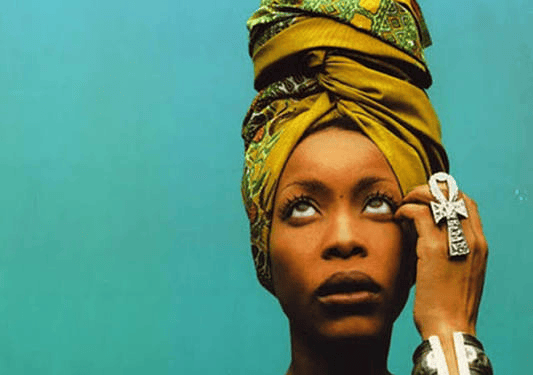
Erykah Badu has been dubbed the “Queen of Neo-Soul ” but her aesthetic is undeniably Hip-hop. Badu is completely Hip-hop. You can hear it in her rhymes and see it in her wardrobe. For all of Erykah’s life, she has always aspired to self-create. Born February 26th, 1971 in Dallas, Texas as Erica Abi Wright she knew she was a star meant to shine bright. By the age of four Erica was dancing and singing at her local theater the Dallas Theater Center. As she progressed and developed into her adolescent years she began freestyling and rapping on local radio stations. It was also at this time at the age of fourteen that she decided to change the spelling of her name from Erica to Erykah. This spelling of Erykah is a reference to the Arabic word Kah which means “Inner-self”. In addition to the change of her first name, Erkyah undertook the surname Badu which comes from Ghanaian Akahn people who use the word to exclaim the tenth-born child. The changes in name signify not only Erykah ridding herself of her “slave name”, but the changes also were ways for Erykah Badu to obtain knowledge of self. A foundational principle of the NGE is the “knowledge of self”.
You may not be too familiar with the NGE but if you listen to Hip-hop at all then you are inevitably familiar with their language. If you have ever greeted a friend with “What’s up, G?” or
said to a colleague “Let’s build” you have engaged with the 5-Percent. The NGE was founded in the streets of Harlem in 1964 by Clarence 13x.
Clarence 13x known by 5-percenters as Allah The Father was born in 1928 in the Jim Crow South, Danville, Virginia. Allah The Father was born Clarence Edward Smith, and much of his primary and adolescent years were spent in Virginia. At the age of 18 in 1946, Smith moved with his mother to Harlem. Upon his arrival in the Big Apple, Smith had little sense of direction. Looking for a sense of direction Smith enlisted in the United States Army. Smith enlisted as an infantryman in the middle of the Korean War. Thus, with his enlistment, he was stationed in Korea for two years from 1952 to 1954. Through his time in Korea and his service, Smith developed a keen appreciation and skill for Karate. While Clarence was training his body with Karate, his wife Dora was back state-side in Harlem training her mind, body, and spirit with the Nation of Islam (NOI).
Returning to Harlem Smith joined his wife in converting to the NOI. In his conversion, Smith joined the historic Mosque Number 7 and undertook the name Clarence 13x in 1961. After joining the NOI Clarence 13x made fast progress up the ranks of the NOI as he studied the NOI’s philosophies and doctrines with great discipline. It was with this discipline that he was presented with leadership opportunities such as teaching Karate and being selected to serve in the Fruit of Islam (FOI). The FOI is the security force of the NOI, these are the fresh-looking brothas you see in the big red bow-ties. However, this fast track up the ranks was brief as there was great tension among the central leaders of the NOI like Malcolm X and Elijah Muhammad. There were several reasons for such tensions, but Clarence 13 x’s biggest point of contention was the nature and divinity of God.
Largely the NOI believes that Wallace Fard Muhammad, who founded the NOI in Detroit, Michigan in 1930 was a messenger of God. Wallace Fard Muhammad professed Black exceptionalism and Islam were the spiritual drivers that would free Blacks. In this way, Wallace Fard Muhammad became seen as a messiah. Clarence 13x found an issue with this as he believed God was not a singular person, but rather God was in all Blacks. Thus, Clarence 13x understood that the “Black man is God”. He also came to this disbelief in Wallace Fard Muhammad because Wallace Fard Muhammad’s mother was white, therefore there was no way that Wallace Fard Muhammad could be the one true God. With this understanding, Clarence 13x left the NOI in 1963. Leaving with Clarence 13x was John 37x. Despite their departure, the two men continued to study the dogma of the NOI. In this revision of study, Clarence 13x took the name of Allah The Father.
With this new namesake, Allah The Father founded the NGE in 1964. In creating the NGE, he drew heavily on the lessons of the NOI like the ‘Lost Lessons’. While drawing on these lessons the NGE is distinct from the NOI as it is a belief that Black men are Gods.
Gods are built and then born. In the NGE, Gods are built when they “live the mathematics”. Supreme Mathematics for the Nation of Gods and Earths is a system of numbers with attached meanings and values. Mathematics helps the Gods understand the way of the world and themselves. The mathematics are as presented by Allah the Father. The mathematics that this project is concerned with are 1, 2, 3, 7, and 0 and they are as follows:
– 1. KNOWLEDGE: IS THE FOUNDATION OF EVERYTHING IN EXISTENCE. KNOWLEDGE IS TO KNOW AS SUCH AS THE SUN IS THE FOUNDATION OFTHIS SOLAR SYSTEM THAT THE BLACKMAN IS THE FOUNDATION OF HIS FAMILY. KNOWLEDGE IS TO LOOK, LISTEN, AND OBSERVE. KNOWLEDGE IS THE FIRST STEP TOWARD RIGHTEOUSNESS.
- – 2. WISDOM: IS THE WISE WORDS SPOKEN BY THE WISE MAN. WISDOM IS THE MANIFESTATION OF THE FOUNDATION, WHICH IS KNOWLEDGE.
- – 3. UNDERSTANDING: IS THE BEST PART OF LIVING MATHEMATICS. IT IS TO SEE WITH THE THIRD EYE, WHICH IS THE MIND. IT IS ALSO A PICTURE ONE DRAWS FROM KNOWLEDGE AND WISDOM.
- – 7. GOD: IS THE SUPREME BEING BLACKMAN FROM ASIA. HE IS THE ORIGINAL MAN, MEANING THE ORIGIN OF ALL, THE MAKER AND THE OWNER, THE BUILDER AND DESTROYER.
- – 0. KNOWLEDGE ADD ON CIPHER: KNOWLEDGE IS TO KNOW AND TO KNOW IN ORDER FOR TO KNOW. ONE MUST HAVE THIS KNOWLEDGE. CIPHER IS A CIRCLE CONSISTING OF 360 DEGREES OF KNOWLEDGE WISDOM-UNDERSTANDING WHICH IS LIFE. The majority of the West uses the Indo-Arabic numeral system. In this system, the count starts with the digit zero. And zero represents in the Indo-Arabic system no value, the absence of value, or nothing. But in Supreme Mathematics, zero does not just represent nothing, but rather it represents completeness or fulfillment. In Supreme Mathematics zero is a circle, it is the cipher. Cipher is the beginning and the ending, it articulates evolution. Just like a circle, a cipher is 360 degrees. In addition to living the mathematics, the Gods study a series of 3 120 lessons. Once thelessons are mastered Gods reach 360 degrees of understanding. Therefore, it is believed that Gods have obtained “knowledge of self” upon mastery of the 360 lessons.
The NGE is Hip-hop as its influence can be heard in many of the words of the Hip-hop greats. For instance, Supreme Mathematics can be heard when Rakim Allah rapped the song ‘Move The Crowd’
With knowledge of self there’s nothing I can’t solve at 360 degrees I revolve.
Likewise, when Jay-Z rapped on ‘Run This Town’
Please follow the leader, so Eric B we are Microphone fiend, this the return of the God, Peace, God.
Here, Jay-Z not only engages in a mediation of intertextuality with Rakim and Eric B, but he sees Rakim and Eric B as Black men, and himself as a Black man as Gods.
Knowledge of self is not the only aspect that inspires Hip-hop, but the cipher is another critical idea that Hip-hop has adopted from the NGE. The cipher is not just a digit in the Supreme Mathematics nor a series of lessons to be completed, but it also is a deeply spiritual physical space for the NGE. In one way the cipher is a space for the Gods to connect with their ancestors as it reminds them of the ring shout. The ring shout was a communal practice that brought enslaved Black people together through music. The music was made by clapping, stomping, and singing. The ring shout was a space in which enslaved Black people could be in community. It functioned as a space for enslaved Black people to come together to defy the logics of white supremacy while taking control of the movements of their bodies. For 5-
Percenters, the cipher functions in a similar manner as Gods kick knowledge and provide wisdom to protect themselves and challenge antiBlackness. Along with this spiritual practice, Gods rebuild and refine themselves in the cipher. Now, in Hip-hop, historically artists often convene in a public space like Washington Square Park, 125th Street in Harlem, or on the Block of Fulton Street to kick freestyles, share knowledge, trade flows, and dish out beats. Thus, these public convergences act as ciphers and we call them ciphers. In the cipher, Hip-hop artists and rappers refine their skills and build their artistry. The cipher helps artists to evolve in community. In turn, the cipher presents itself as a Block in which young Black folks come together to articulate new ideas of themselves and to imagine new understandings of what it means to be Black in the world.
In what has just been shared regarding the NGE there was no discussion of women. With the absence of gender in the above conversation the NGE would appear to be an organization that centers men and is patriarchal. Acknowledging such a centering I call attention to one of the many critiques of the NGE. Many of those who are in opposition to the NGE claim it to be misogynistic and chauvinistic. With what was said above I understand the critique, and I think it is a fair one. I am not going to use this section to challenge this critique because I recognize its validity. However, I would like to push the conversation forward by exploring the nuances of gender in the organization. As aforementioned it was stated that the NGE understands that the Black man is God. It should also be stated that Allah The Father also believed that the physical body is a vessel for Blacks to see themselves as Gods as Allah can be broken down into Arm, Leg, Leg, Arm, and Head. Thus, there is no distinguishing between masculine and feminine because Allah The Father believed all Black People had the capacity to be God. While
historically in the NGE, it was the belief that the Black man was God, Black women were called Earths. Alternatively, there are women in the NGE who are referred to and refer to themselves as Goddesses, or simply as God. Erykah Badu is one of these women.
In 1997 Erykah Badu released her debut album ‘Baduizm’ at the age of 26. Naming her album ‘Baduizm’ the album acts as a scripture outlining Badu’s personal philosophies which are influenced by the NGE. Badu uses the philosophies on this album to demonstrate that she indeed has the knowledge of herself as a God, while also stressing the importance of the cipher to encourage others to develop a sense of self towards a path of new possibilities for a Black social life.
Upon its release, ‘Baduizm’ was met with great success and critical acclaim. Erykah Badu and ‘Baduizm’ were the talks of the town at the 1997 Grammys as Badu was nominated for six Grammys, and of those six nominations, she took three home. ‘Baduizm’ was not just a great album for 1997 but it has stood the test of time. In 2020 Rolling Stone listed ‘Baduizm’ as the 89th out of 500 greatest albums ever made. This classic album continues to get play across several different generations of listeners. ‘Baduizm’ has an intergenerational appeal as the messaging and content of this album has universal meaning. While the album is a masterpiece and is brilliant all the way through, there are two tracks where Badu explicitly expresses her ideas of the world. The two tracks are listed back-to-back on the album, track 2 (Wisdom) is titled ‘On & On’, and track 3 (Understanding) is titled ‘Appletree’.
Fading away from the intro track titled ‘Rim Shot (Intro)’ is the second track ‘On & On’. ‘On & On’ is produced by the multiplatinum-winning iconic producer, engineer, and composer
Bob Power as well as the legendary and iconic songwriter and producer Jahmal “JaBron” Canterero. The song was written by JaBron and Badu. Badu sings on and on, sharing messages of knowledge of self, while also dictating her own divinity. Badu begins this song by equating the value of knowledge to material wealth singing
If your knowledge was your wealth, then it would be well earned.
In this articulation, Badu places a premium on knowledge as a way to say individuals earn their knowledge, and once they obtain their knowledge, they own it. However, Badu is not talking about just any type of knowledge nor general knowledge that is developed through schooling, but rather a different type of knowledge. Badu is talking about the knowledge of self. For Badu, she has the knowledge to know herself and others as Gods as she cries out throughout the song
If we were made in his image then call us by our names. Most intellects do not believe in God but they fear us just the same.
It is with this proclamation that Badu shares several powerful sentiments. The first being is that she expresses a knowledge of self that is consistent with the NGE. She then teases out the way in which many Western philosophers and thinkers like Charles Darwin or Karl Pearson, who are atheists combine this atheism with science to justify antiBlack ideals that say Blacks are less intelligent, animal-like, irrational, and ultimately not human. Badu claims these intellectuals say these things because they fear what happens when Black folks know themselves. In turn, Badu pushes back by urging Blacks to truly know themselves. Badu understands that the message of knowledge of self is disruptive, but she uses this song to create buy-in for other Black folks to join her on the quest to knowledge of self. Building this understanding, Badu sings
Oh, on and on and on and on. My cypher keeps moving like a rolling stone. Woo, on and on and on and on.
In this pursuit of this knowledge and her encouragement of others, she invites others to join her cipher and continue to seek a true knowledge of self. Despite this disruptive message and what it may cause Badu continues to fight singing
Ooh, on and on and on and on. God dammit, I’mma sing my song. And dammit she continues to sing her song.
She continues this tune on track 3 ‘Appletree’. While she encouraged others to join, she realizes not everyone will join her cipher she expresses this idea singing
And if you don’t want to be down with me, you don’t want to pick from my Apple tree.
An apple is a symbol of knowledge that is why we give teachers apples. Badu uses this imagery to point out that her knowledge may not be for everyone, but she is fine with that. Despite knowing she won’t get everyone on board she still continues to produce knowledge and followers as she rings out
I have a hoe. And I take it everywhere I go,’ cause I’m plantin’ seeds so I reap what I sow, ya know, ya know. On and on, and on and on, my cypher keep’s movin’ like a rollin’ stone. I can’t control the soul flowin’ in me.
With these lyrics she indicates on this track and the prior track that she is living out the Mathematics of knowledge, and she passes this knowledge around to dish out wisdom. Badu understands that the knowledge of a collective or cipher will be the thing to carry the cipher forward. Finally, she articulates that if you have knowledge of self, knowledge will flow through you in order for you to be a God.
Badu continues to share her perspective and philosophies on her sophomore album titled ‘Mama’s Gun’. ‘Baduizm’ set a high bar for Badu, so she knew she needed to go even harder. ‘Mama’s Gun’ is successful in its own right, ranking 158th of the Rolling Stone’s 500 greatest albums. To try and eclipse the success of ‘Baduizm’ Badu called on J Dilla, the hottest producer at the time. Badu released ‘Mama’s Gun’ on November 21st, 2001. Badu not only builds on top of the philosophies from ‘Baduizm’ but she gives birth to new thoughts. She kicks off ‘Mama’s Gun’ by wrestling with the question of what does it mean to live life as a Black person? Badu equates this life to living in a penitentiary, thus she names this intro track ‘Penitentiary Philosophies’. Moreover, she details this sort of life as a “prison life”. For Badu, this prison life is one of poverty and a space where there seems no way out or up, so she sings,
Here’s my philosophy. Livin’ in a penitentiary. Brothers all on the corner. Tryin’ to make believe. Turn around ain’t got no pot to pee. Make me mad when I see ya sad. Can’t stand to see ya hustle doin’ bad. But you can’t win when your will is weak. When you’re knocked on the ground.
Despite this feeling of being stuck, Badu knows just like she knows herself that there is a way out.
On the second track, titled ‘Didn’t Cha Know’ Badu seeks a way out. She begins this track by admitting that she feels lost. Badu explains this feeling of loss by singing
I’m trying to decide which way to go. Think I made a wrong turn back there somewhere.
In addition to this feeling of being lost in space, she also feels lost in time and that there is not enough time as she cries out,
Time to save the world. Where in the world is all the time? So many things I still don’t know.
Through this pouring out Badu continues to try and grapple with space and time by singing in the chorus
Didn’t cha know, didn’t cha know. Tried to run but I lost my way. Didn’t cha know, didn’t cha know. Stopped to watch my emotions sway. Didn’t cha know, didn’t cha know. Knew the toll but I would not pay. Didn’t cha know, didn’t cha know. I said ya never know how the cards may lay.
It is in this chorus that Badu begins to make sense of a Black life outside of prison as she arrives at a consciousness where simply
Love is life, and life is free.
Badu brings this consciousness forth and to the stage at ‘Dave Chappelle’s Block Party’. Erykah Badu hit the stage wearing an Afro, a yellow blazer with a Black Panther Button on her left lapel, and jeans. Donning this look, it is nearly impossible to not see the spirit of Angela
Davis in the performance of Badu. Just like Erykah Badu, Angela Davis knew from a very young age her vocation. Angela Davis was born in 1944 in the “Dynamite Hill” neighborhood of Birmingham, Alabama. Dynamite Hill was a segregated Black neighborhood and got its nickname from the frequent bombings from the Ku Klux Klan. It is these experiences and the witnessing of the 1963 bombing of the 16th Street Baptist Church that led Davis to a life of activism. Angela Davis is well known for being a radical Black Panther who was once put on trial for murder, kidnapping, and conspiracy but she beat the case representing herself. Davis is a professor and activist. Just like how the 5-Percenters influenced Hip-hop, the Black Panthers also influenced Hip-hop, as Hip-hop grew out of the Black Power Movement that was taking place in the 1970s. It is evident to see the spirits and soul of the Black Power Movement in Badu as she sings in front of the crowd ‘Back in the Day’ which is the third track of her third album titled ‘Worldwide Underground’. Singing this song before the crowd Badu shows appreciation and a validation of the knowledge of those who came before her as well as the various movements like the Black Power Movement. Badu exhibits this appreciation by caroling,
Back in the day when things were cool, hey. All we needed was bop-bop, bop-bop, bop- ba-domp. Ooh, bop-bop, bop-bop, bop-ba-domp.
With this chanting Badu articulates all we need is ourselves, our vibrations, and each other to be cool as ourselves. She also reminds us of simpler times as she sings
Wailin’ and singin’ and jammin’ and talkin’. And pumpin’ the trunk with the windows rolled up, puff. Well, well, well. The laughin’ and singin’ and jammin’ and talkin’.
With this reminder Badu ultimately reminds us amidst a prison life that joy is possible with being able to freely laugh, jam out, and rejoice in song.
Then in her performance, Badu gives the audience a pathway forward as she sheds her Afro because of the wind, removes her blazer and is left with her natural hair. She is wearing a Black T-Shirt with white letters that spell out “Coroner”. It is in this shedding that Badu prophesied that in order to move forward we must examine like a coroner not only our past but the current moment as well. As she also encourages us to learn about ourselves, so that we may see ourselves as Gods. In this way and in her performance, Badu writes herself and her cipher out of the wake of prison life by giving Black people joy as they watch her performance.


Leave a Reply